The Problem
Regulated organisations want AI systems that act — not just summarise. They want an agent that retrieves the relevant control from a policy document, assesses how a proposed change affects it, and creates a ticket to track the gap. The operational desire is clear. The architecture problem is not.
A single monolithic LLM call that retrieves, reasons, and acts cannot be audited. You cannot explain which document grounded which claim, which agent made which decision, or whether a human reviewed the action before it executed. In a regulated environment, an answer that cannot be traced to a specific source is not an answer — it is a liability. An action that executes without human review is not automation — it is risk.
The architecture challenge is not building an agent that can do these things. It is building one that does them under governed control — with an audit trail that satisfies a compliance team, a guardrail layer that satisfies a CISO, and a human approval gate that satisfies both.
How It Works — The Golden Workflow
A compliance question arrives. Three specialist agents handle it in sequence, supervised by a LangGraph state machine. Every transition is traced in LangSmith and appended to an immutable PostgreSQL audit log.
Denied topics (hacking, evasion, harmful content) and PII patterns are caught at the boundary. The request never reaches the supervisor if it fails. Application-level guardrails — API-compatible with AWS Bedrock Guardrails for the production swap.
The question is embedded and run through a cosine similarity search over seeded regulatory documents using pgvector with an HNSW index. The knowledge base covers ten frameworks across 15 chunks: GDPR, ISO/IEC 27001, Basel III, OSFI E-23 (2025 final, effective May 2027), OSFI B-20, PIPEDA, NIST AI RMF, EU AI Act, ISO/IEC 42001, and AI Governance Principles. Top-k chunks are returned with source metadata. A RETRIEVAL_MODE=hybrid config option fuses that vector search with Postgres full-text search via reciprocal rank fusion — off by default, since at 15 documents the honest answer is that it doesn't move the needle much yet, but the pattern is in place for when the corpus grows past hand-seeded reference text (ADR-007).
Retrieved chunks are assembled into a structured context block. The agent is prompted to cite every factual claim with a numbered reference — un-cited claims are flagged before emission, not just discouraged. Hallucination is constrained structurally, not just instructed against.
PII patterns and harmful content are caught on the response, not just the input. Both layers are production-swappable to AWS Bedrock Guardrails as a configuration change.
The Action Agent generates a structured proposal: a Jira ticket or GitHub issue with title, body, and labels. The TICKET_BACKEND environment variable switches between integrations — both use the same proposal schema. LangGraph's interrupt_before pauses the graph here. A human must explicitly approve or reject before any write executes. Rejection is also logged.
Every agent step, tool call, human decision, and action outcome is appended to the PostgreSQL audit log with a UTC timestamp. BEFORE DELETE and BEFORE UPDATE triggers raise an exception on any modification attempt — immutability enforced at the database level, not by convention.
The system view above — client, FastAPI ingress, LangGraph supervisor, Neon Postgres, and the external model/ticket/tracing services, including the hybrid-retrieval and dual ticket-backend paths — is diagrammed in FigJam, editable and open for anyone with the link: open the architecture diagram →
The Governance Layer
Six non-negotiable pillars make this system auditable, safe, and honest for a regulated environment. Each maps to a production AWS equivalent described in the ADRs — the production swap is a configuration change, not a rewrite.
Application-level screens for denied topics, PII patterns, and harmful content on both the question and the response. API-compatible with AWS Bedrock Guardrails — production swap is a single config change.
Every agent step, tool call, and human approval appended to PostgreSQL. A database-level trigger prevents any DELETE or UPDATE. The log is tamper-proof by design — not by convention.
The Action Agent proposes write actions — it never executes them. interrupt_before pauses the LangGraph graph until a human explicitly approves. The graph state is preserved during the pause; approval resumes exactly where it stopped.
Every factual claim must carry a numbered source reference. Responses where is_cited=False are flagged before emission. Hallucination is constrained at both the prompt and the enforcement layer.
The Bedrock IAM user is scoped to bedrock:InvokeModel on target model ARNs only — no other AWS permissions. In production on AWS compute, this becomes an IAM role with no long-lived access keys at all. See ADR-005.
Every agent step and LLM call is traced in LangSmith — supervisor routing, retrieval results, draft generations, guardrail decisions. The full graph execution is visible, replayable, and attributable to a specific run ID.
demo / demo123 — access code on request via LinkedIn. Pre-warm note: Railway services sleep after 30 min of inactivity; if the first request is slow (10–30 s), that is a cold start — subsequent queries are fast.Two-Tier Deployment Strategy
The system is architected across two tiers. The current tier runs at under CAD $35 per month — a deliberate cost decision, not a constraint. Moving to the production tier changes the infrastructure; it does not change the application code. The full transition map is documented in ADR-004.
| Concern | Current Tier | Production Tier (AWS) |
|---|---|---|
| Compute | Railway (FastAPI container) | AWS App Runner / ECS Fargate |
| Database | Neon (pgvector) | Aurora Serverless v2 + pgvector |
| Models | OpenRouter → GLM 5.2 | Amazon Bedrock (direct) |
| Auth | IAM access key (scoped, Bedrock only) | IAM role — no long-lived keys |
| Secrets | Railway env vars | AWS Secrets Manager |
| Networking | Public Railway URL | Private VPC + WAF |
| Always-on | No — sleeps after 30 min idle | Yes |
| Monthly cost | ~CAD $20–35 | ~CAD $150–300+ |
The cost-optimisation in the current tier is not accidental — it is documented. ADR-004 maps every infrastructure component to its AWS equivalent, states the trigger that would prompt migration (sustained load or enterprise-scale requirements), and quantifies the cost delta. The architecture makes the transition path explicit before it is needed.
Architecture Decision Records
Seven ADRs document the deliberate trade-offs in this system. Each captures the context, the options considered, the decision, and the consequences — the artefacts that distinguish an architecture engagement from a development project.
| ADR | Decision | The Trade-off |
|---|---|---|
| ADR-001 | LangGraph vs. Amazon Bedrock Agents | Self-orchestration keeps the graph portable and inspectable; managed runtime reduces operational overhead in production |
| ADR-002 | pgvector co-located vs. dedicated vector DB | One PostgreSQL instance for both retrieval and audit eliminates a service; at production scale, a dedicated vector DB (Aurora pgvector or OpenSearch) separates these concerns |
| ADR-003 | Bedrock Guardrails configuration for regulated industries | Application-level guardrails in demo tier; managed Bedrock Guardrails in production add PII redaction, denied topic enforcement, and grounding checks at the API boundary |
| ADR-004 | Railway Hobby vs. AWS App Runner / ECS Fargate | Railway costs ~CAD $35/month with zero infrastructure management; AWS production path costs more but provides IAM roles, private networking, always-on SLA |
| ADR-005 | OpenRouter (demo) vs. Amazon Bedrock (production) | OpenRouter with z-ai/glm-5.2 costs pennies per query at demo volume (the free gemma-4-31b-it tier is kept only as a rate-limited fallback); Amazon Bedrock provides SLA, IAM-native auth, private VPC endpoints, and model versioning guarantees for production. The application code does not change — only the endpoint and auth config |
| ADR-006 | Azure OpenAI as a validated, config-only alternate provider | For Azure-committed engagements, MODEL_PROVIDER=azure_openai swaps in deployment-name-based routing with the same embedding model — no application code change, validated end-to-end against a real Azure OpenAI resource |
| ADR-007 | Pure vector search (default) vs. hybrid search (config option) | Retrieval was never explicitly hybrid-vs-vector deliberated in earlier phases — it was simply out of scope. RETRIEVAL_MODE=hybrid fuses pgvector cosine and Postgres full-text via reciprocal rank fusion (not score-blending, which fails to normalize cosine similarity against ts_rank); default stays vector-only until the eval harness shows it earns its complexity at this corpus size |
Enterprise AI Assurance Framework
The evaluation layer treats this agent as a system-under-test and generates audit-ready evidence — not just a metrics dashboard. It runs independently of the agent, calling the live API and scoring its actual outputs against a curated golden dataset.
Scores the agent on faithfulness, answer relevancy, context precision, context recall, and refusal correctness against 15 curated question/answer pairs with ground-truth contexts. Mock mode runs with no API keys; live mode queries the deployed agent.
Auto-generated MRA report mapping evaluation results to architectural controls — the artefact a model-risk committee or CRO consumes, not a developer dashboard. Generated from a live evaluation run against the deployed agent and downloadable as a designed PDF directly from the demo's Assurance panel.
Eight controls mapped to NIST AI RMF functions and OSFI Guideline E-23 (effective May 2027) in control_mappings.yaml. The same engine leads with E-23 in FSI conversations and NIST/ISO everywhere else — one mapping file, not a different product.
Human-in-the-loop, append-only audit logging, and guardrails are assessed as observed architectural controls (CTL-06 to CTL-08) — not self-declared. The assurance framework verifies the governance claims in the ADRs against actual system behaviour.
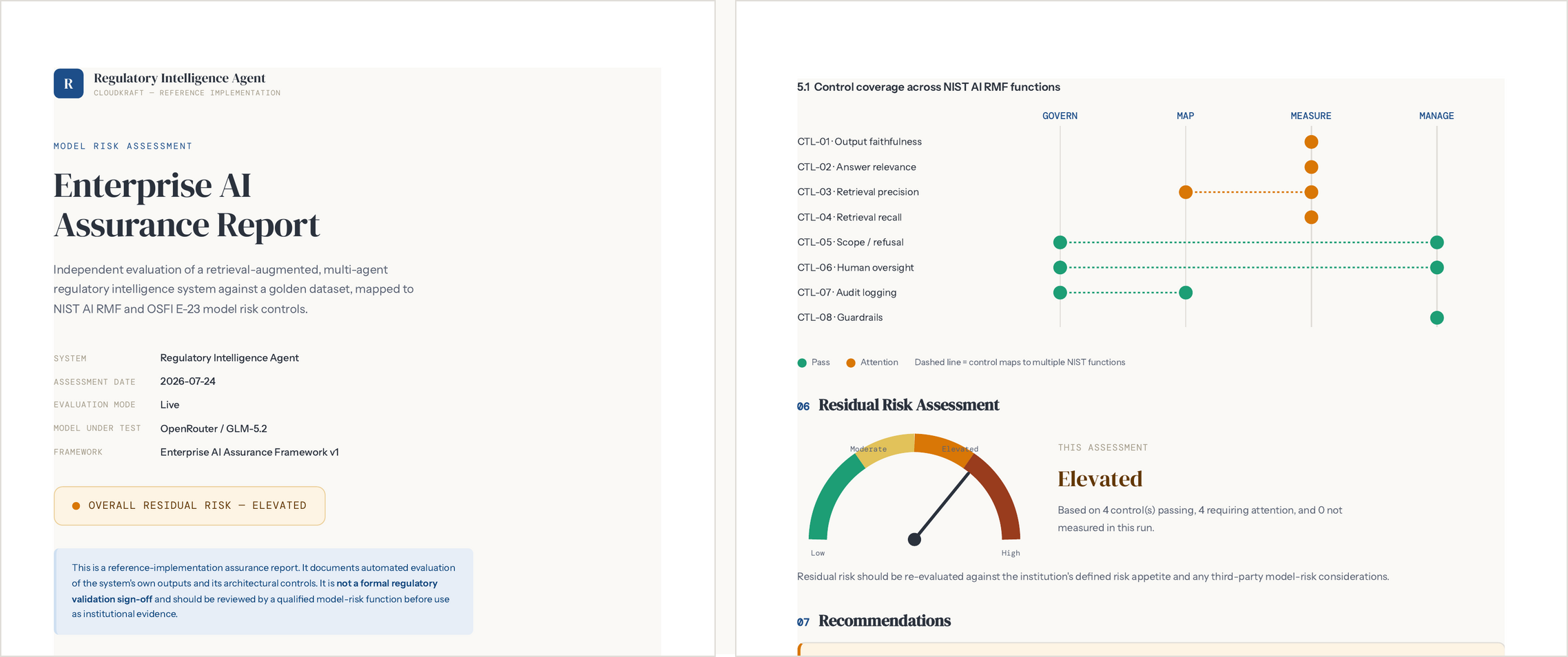
Canadian FRFIs are inside the transition window for OSFI E-23 (effective May 2027), which extends model-risk expectations to AI systems. The gap across all governance frameworks is the same: organisations can describe controls but struggle to produce repeatable, output-level evidence that the controls hold. This framework produces that evidence.